

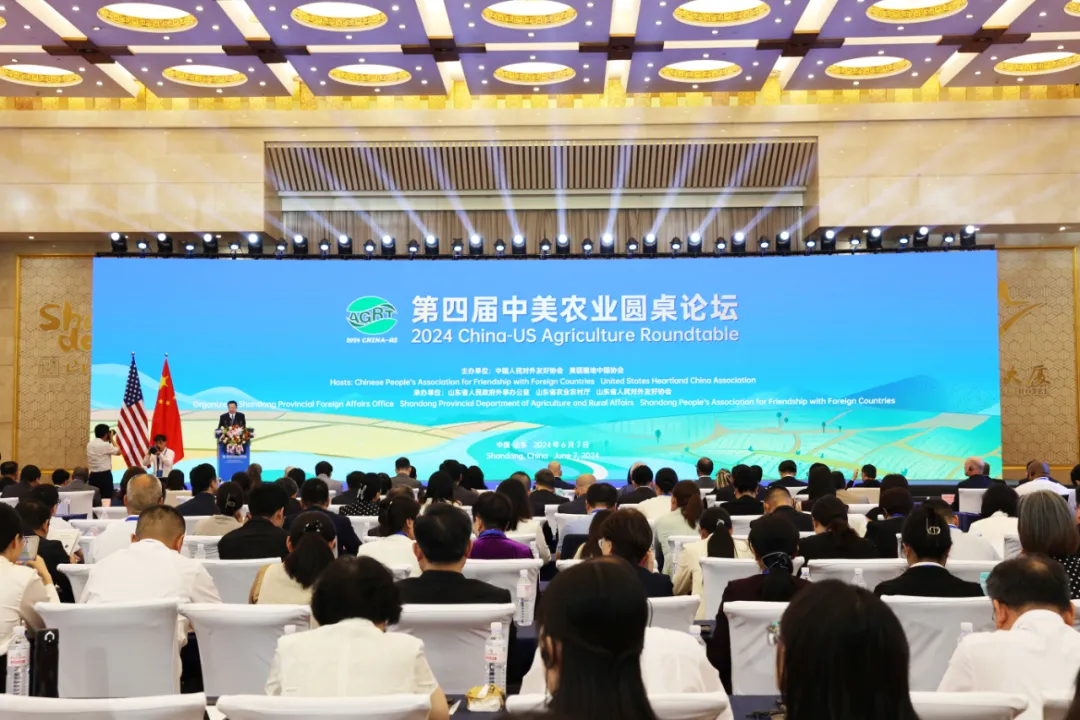
 On June 7, 2024, the Fourth China-U.S. Agriculture Roundtable Forum, hosted by the Shandong Provincial People's Association for Friendship with Foreign Countries, was held at the Shandong Mansion. The grand event brought together over 200 participants, including representatives from Sino-American industry associations and enterprises such as Shandong Agricultural University, the American Soybean Association, Bayer, ADM, Dabeinong, and Shandong Shunfeng Biotechnology, alongside experts, scholars, faculty, and students from agricultural institutions. Li Shunxiu, General Manager of Shandong Yuwang Ecological Food Industry Co., Ltd., was invited to attend as the sole representative of China's soybean deep processing industry and delivered a significant speech at the forum.
The opening ceremony was presided over by Deng Yunfeng, Vice Governor of Shandong Province. Zhou Naixiang, Governor of Shandong Province, delivered the welcome address. Addresses were also given by Yang Wanming, President of the Chinese People's Association for Friendship with Foreign Countries; Susan Thornton, Vice Chairman of the U.S. Heartland China Association; Nicholas Burns, U.S. Ambassador to China; and Robert Hanson, Minister-Counselor for Agricultural Affairs at the U.S. Embassy in Beijing, representing the U.S. Department of Agriculture. Vice Governor Chen Ping delivered a promotional speech. This was followed by the release of outcomes, covering cooperation mechanisms, product transactions, cooperative projects, and exchange plans.
The Forum on Technological Innovation and Agriculture was moderated by Jing Qiaoni, President and CEO of Genective. Presentations were given by Niu Xiaomu, Chief Scientist and Deputy General Manager of Shandong Shunfeng Biotechnology Co., Ltd.; Shi Libo, Technical Director for North China at Syngenta China MAP & Sinochem Agriculture; Li Shunxiu, General Manager of Shandong Yuwang Ecological Food Industry Co., Ltd.; Bob Perlas, Director of the United Soybean Board; and Zhang Chuanqing, General Manager of Dabeinong Chuangzhong Gene Technology Co., Ltd. Together, they explored issues related to global technological innovation and agricultural development.
Li Shunxiu introduced that the Yuwang Group is a national high-tech enterprise and a national key leading enterprise in agricultural industrialization, focused on soybean deep processing and integrating big health and new materials. Its products have passed FDA inspection exemption certification. Yuwang has always placed high importance on technological innovation, pioneering low-temperature desolventizing technology, high-gelatinization soybean protein technology, and trypsin inhibitor separation and purification technology. It has independently innovated core equipment for processing low-temperature soybean meal and isolated soybean protein, driving the development of China's non-GMO soybean national industry, domestic soybean protein equipment manufacturing, and the soybean protein deep processing sector. This also lays the foundation for the future oral administration of protein-based drugs.
Yuwang's mission is "For Ourselves, For Saving the Planet, let safe and trustworthy plant-based protein foods bring healthy and long lives to humanity!" The company is committed to partially replacing animal meat with plant-based meat, which holds significant strategic importance for improving human dietary structure, promoting human health and longevity, and protecting the global ecological environment. Taking Yuwang as an example, the annual production of 120,000 tons of soybean protein, compared to beef providing an equivalent amount of protein, can save 44.11 million mu (approximately 2.94 million hectares) of arable land, equivalent to 1.4 times the arable land area of Guangdong Province. It can reduce carbon dioxide emissions by 12.19 million tons, which would require 500,000 mu (approximately 33,333 hectares) of broad-leaved forest to absorb in one year. In 2023, Yuwang's project for an annual production of 20,000 tons of plant-based meat product series was completed and put into operation, accelerating the industrialization and marketization of plant-based meat and advancing steadily in line with its mission and vision.
Regarding the key technological innovations driving the vigorous development of China's soybean deep processing industry, Li Shunxiu identified low-temperature desolventizing technology as a crucial breakthrough. In the 1990s, China built over 20 new soybean protein production lines but lacked qualified low-temperature soybean meal raw material. After technological攻坚, Yuwang launched high-quality low-temperature soybean meal in 1998, spurring the development of China's soybean protein processing industry. Based on its core manufacturing capabilities, Yuwang has formulated a "Length is Strength" development strategy, expanding the entire chain upstream to breeding and planting, and downstream to plant-based protein foods. Through horizontal integration and vertical integration, it has formed a whole-industry-chain development model of "soybean breeding - planting bases - processing and manufacturing - terminal sales," becoming a backbone force in the innovation and transformation of China's soybean industry.
Regarding the next wave of technological innovation, Li Shunxiu believes that, considering current global technological frontiers and future key trends, the development priorities for the entire soybean industry chain are, first, integration with cutting-edge biotechnologies, such as using gene editing to breed new specialty soybean varieties like high-oleic acid soybeans, and using microbial fermentation to produce new food ingredients like hemoglobin and myoglobin for high-quality plant-based meat production. Second, the integration of digital and intelligent technologies within the soybean processing industry to form automated and intelligent industrial models, reducing labor intensity and density, and enhancing industrial efficiency.
On global food security and agricultural cooperation, Li Shunxiu emphasized that with the continuous growth of the world's population, the global supply and demand for food, particularly the gap in meat products, will gradually intensify. Livestock farming causes significant resource consumption, affecting the sustainable development of the global environment. Plant-based meat offers higher protein production and conversion efficiency, demonstrating clear advantages in improving food supply and demand and mitigating resource and environmental impacts. With the rise of global plant-based foods, the market size for plant-based meat is expected to reach trillions of RMB. However, the industrialization, marketization, and branding of plant-based meat products are progressing relatively slowly.
On one hand, competing with animal meat for market share is a challenge the plant-based meat industry must face and undertake. Achieving fundamental breakthroughs in the flavor, taste, and cost of plant-based meat is core. It is essential to be market-oriented and consumer-focused, winning consumer acceptance through taste and flavor. This requires close collaboration between a group of market-oriented, truly capable enterprises and research institutions. It necessitates innovative breakthroughs across multiple disciplines, including gene editing, enzyme preparation, and biological fermentation.
On the other hand, there is a need to intensify global efforts in science popularization and consumption guidance for plant-based meat, helping consumers understand food and consumption choices from the perspectives of nutrition, health, and longevity. Government departments worldwide should provide promotional endorsement, leading enterprises should increase market promotion, and collective societal efforts are needed to promote the high-quality development of the plant-based meat industry.
Participants expressed their commitment to enhancing cooperation across parties to achieve breakthroughs in the flavor, taste, and cost of plant-based meat, strengthen market promotion and science education, and promote the high-quality development of the plant-based meat industry. They highly appraised Yuwang's efforts in fulfilling its mission, actively promoting the replacement of animal meat with plant-based meat, improving human dietary structure, and making important contributions to human health, longevity, and the protection of the Earth's ecological environment.
The event also included a Forum on Climate-Smart Agriculture, moderated by Sarah Lande, Executive Director of the U.S. Heartland China Association. Presentations were given by Wang Yong, Vice President of Shandong Agricultural University; Stan Born, Chair of the American Soybean Association's Trade Policy & International Affairs Advocacy Committee; Gao Yong, Vice President of Public & Government Affairs and Sustainability at Bayer (China); Adam Sinclear, Project Director of the Sorghum Checkoff; and Zhu Bo, Director of Government Relations and Operational Support for ADM China.
This forum provided direction and ideas for agricultural cooperation and development, actively implemented the consensus and outcomes reached between China and the United States, further promoted exchanges in agriculture between the two countries, and held significant importance for fostering the healthy and stable development of China-U.S. relations.